
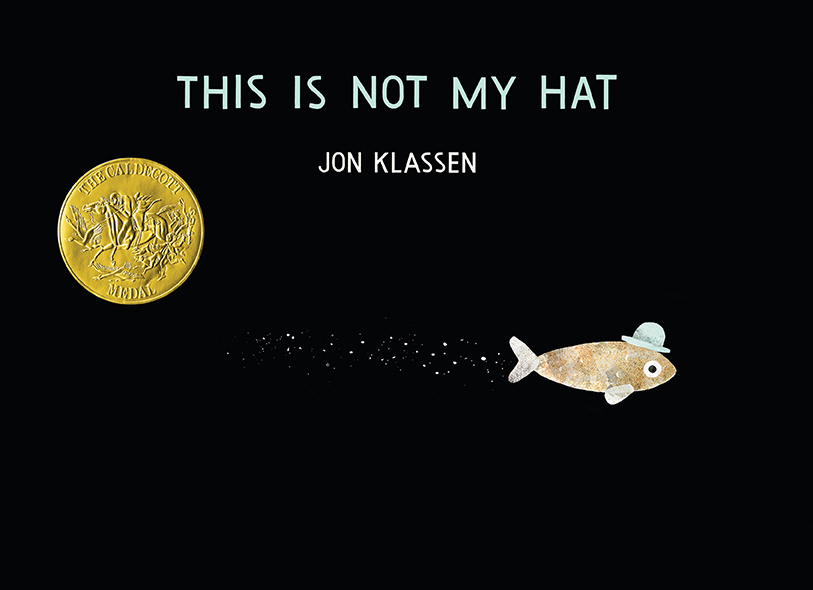
Print picture book This Is Not My Hat, written and illustrated by Jon Klassen, is a story aimed at preschool to 1st grade-aged children, but it’s a delight to all ages. The 2013 Caldecott Medal winner, this is a humorous story about the consequences of one’s actions. Over the course of 16 spreads and 40 pages, Klassen tells his tale with minimal text but illustrations that say so much. At the beginning of the story, a little fish has stolen the hat of a sleeping big fish. He swims toward the tall, dense plants to hide, thinking that he won’t be discovered, but at the climax of the story, the big fish swims into the tall plants behind him. In the end, the little fish is nowhere to be found, and the big fish has his hat back.
The relationship between the text and pictures is one of irony, as the text describes the little fish’s belief that the big fish won’t wake up and discover who took his hat, while the illustrations show just the opposite: the big fish awakening, noticing that his hat is missing, and finding the little fish. Klassen uses dramatic irony, perfectly executed pace, and repetition to tell his story. Using a series of if…then statements, the little fish tells the reader that he doesn’t think the big fish will wake up for a long time, or notice that his hat is gone, or know it was the little fish who took it, or know where he went. The illustrations reveal, however, that this is exactly what is happening. Each spread shows the movement of the fish: first the little fish swimming away, then the big fish following him, then the big fish returning with his hat. The action is happening behind the little fish, so the pace creates suspense as to whether or not the big fish will catch up to the little one. The artistic concept of this book is clever and well-executed, with each spread perfectly timed with the text to create suspense and surprise.
This book would be a fun read for storytime, or a useful text for students to analyze how an author builds suspense and uses dramatic irony. Readers will be drawn in by the high contrast of the black illustrations’ background to the white text background and by the way each spread advances the story, literally moving the fish.

 The Mermaid's Tale