
Category: Book Reviews
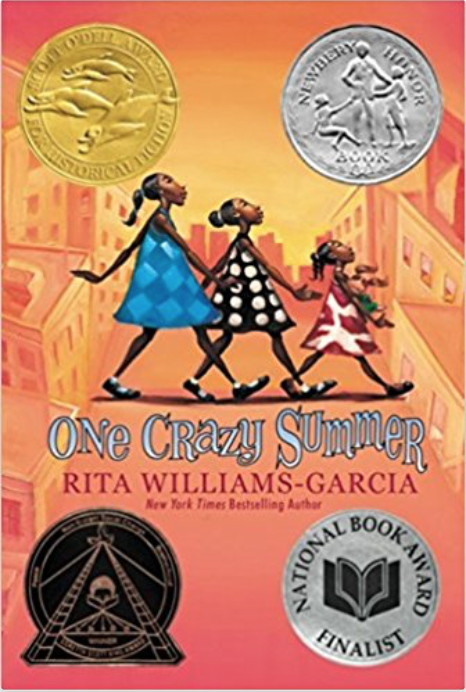
Sisters, Black Panthers, and One Crazy Summer
Newbery Honor novel One Crazy Summer by Rita Williams-Garcia tells a story set in 1968 of three sisters who travel from Brooklyn, New York, to Oakland, California, to visit their mother. Published in 2010 by HarperCollins, this book also is a National Book Award Finalist, a winner of the Scott O’Dell Award for Historical Fiction, and a Coretta Scott King Award winner. This emotional tale for readers in grades 3-7 is narrated by eleven-year-old Delphine, who, at the beginning of the novel, is on an airplane with her younger sisters Vonetta and Fern, making their way across the country to see Cecile, the girls’ mother who abandoned them years before. Their California dreaming of “riding wild waves on surfboards, picking oranges and apples off fruit trees, filling our autograph books with signatures from movie stars we’d see in soda shops” does not turn out to be the reality of their summer, as Cecile sends them to a Black Panther day camp instead. Whether read as part of a school curriculum or simply for enjoyment, readers are sure to be drawn into this equal parts heartbreaking and beautiful story of culture, family, and identity.
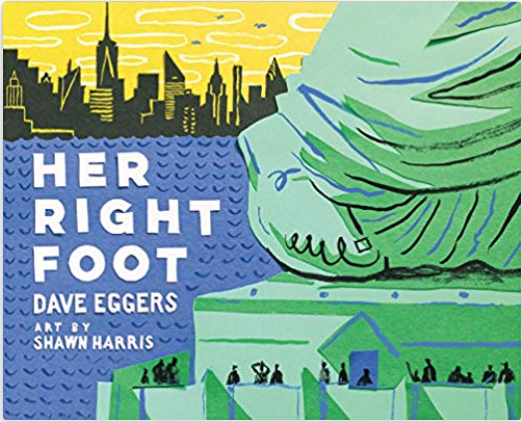
Lady Liberty Is On The Move!
Nonfiction picture book Her Right Foot, written by Dave Eggers and illustrated by Shawn Harris, is a thought-provoking look at a symbol we all recognize: the Statue of Liberty. Eggers, however, does not focus on her face or her torch as he points out that most representations or discussions of her do, but at her right foot, which is mid-stride. Published in 2017 by Chronicle Books, this picture book’s intended audience is children in kindergarten-3rd grade, but the information it presents–who built the statue and where, how it was constructed, what various parts of her represent–may be new to the adult readers of this story as well. Eggers’ notice of the fact that “She is on the move!” spurred him to write this book, asking his readers in a dry, conversational tone to think about the fact that this iconic American symbol of welcome is moving. His theory, vibrantly illustrated by Harris, is that she, herself an immigrant, must continue to meet immigrants “in the sea” rather than standing still and waiting for change. Photos of the statue, as well as a photo of “The New Colossus” sonnet at her base, accompany Eggers’ source notes and suggestions for further reading, making this book one to read to our children, to our friends, to our neighbors to spur thought and conversations around this timely topic.
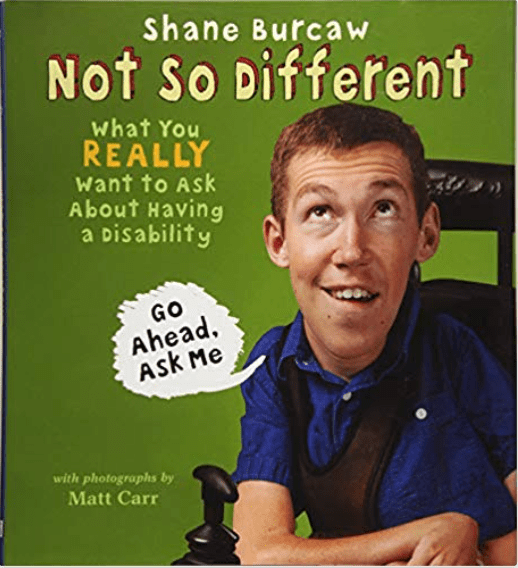
Shane Burcaw Is Not So Different
Nonfiction picture book Not So Different: What You Really Want to Ask About Having a Disability by Shane Burcaw is one that answers questions that the author has encountered about his disability, a disease called spinal muscular atrophy (SMA). Published in 2017 by Roaring Brook Press, the book is formatted with Matt Carr’s colorful photographs of Burcaw and his family interspersed with graphics and speech bubbles, making it accessible not only to its intended audience of students in 1st-4th grades, but to readers of all ages. Questions ranging from “What’s wrong with you?” to “Do people ever make fun of you?” are answered honestly and humorously by Burcaw, addressing topics just about everyone has wondered about those with disabilities and helping readers to see that Burcaw is not so different than them. He informs us that he likes foods like mashed potatoes, mac and cheese, and pizza, sometimes “all at once.” He drives his chair with “a joystick, sort of like a video-game controller.” His author’s note reminds us that “we all have different strengths, weaknesses, and abilities, and that’s not just okay, it’s beautiful.” This book is a wonderful resource to share with children as we seek to educate them about not only those with disabilities, but also about what makes each of us unique and about the ways in which we are all similar.
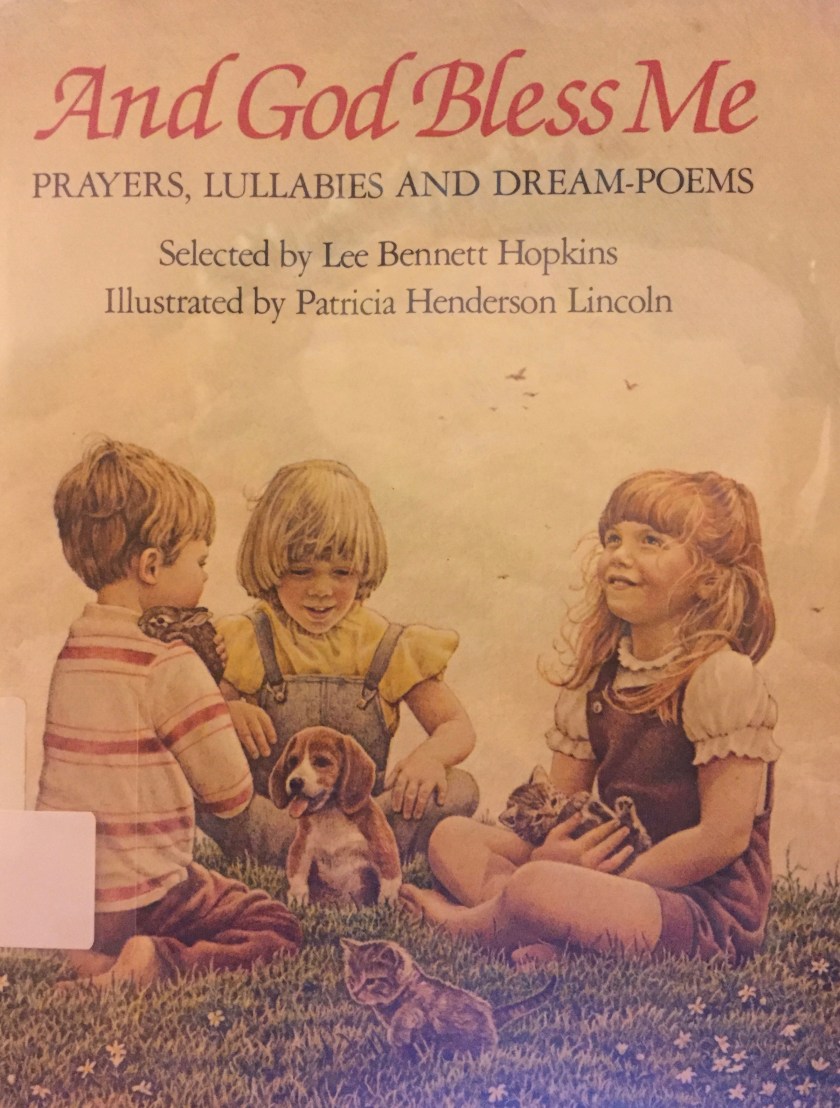
Poems for Bedtime
Compiled by Lee Bennett Hopkins and illustrated by Patricia Henderson Lincoln, And God Bless Me: Prayers, Lullabies and Dream-Poems is a charming selection of poetry for children ages 3-8. Published in 1982 by Alfred A. Knopf, this anthology contains works from such poets as Carl Sandburg, Madeline L’Engle, Langston Hughes, Sara Teasdale, and Lee Bennett Hopkins. Lincoln’s muted color and black-and-white sketches complement the lovely simplicity of the poetry about such topics as bathtime, nighttime, bedtime, lullabies, and prayers. Children and their caregivers will enjoy winding down with these soothing poems at the end of the day.

Words and Music
With verses by America’s first Children’s Poet Laureate Jack Prelutsky and illustrations by Mary GrandPré, Camille Saint-Saëns’ 1886 musical composition The Carnival of the Animals is given new life as a way of introducing children to classical music. Published in 2010 by Alfred A. Knopf, this book contains a CD with a fully orchestrated version of Saint-Saëns’ music as well as dramatic readings of the verses by Prelutsky. Though this book is recommended for children ages 5-8, readers of all ages will enjoy listening to the music and reading Prelutsky’s verses, each one written to match the orchestral representations of a lion, elephants, birds, and other creatures in the menagerie. GrandPré’s richly-colored mixed-media illustrations add additional beauty to the text, making it both visually and aurally pleasing. A note to parents and teachers from the head of the music department of New York’s Rudolf Steiner School is also included, helping caretakers to provide “activities worthy of imagination” for children of different ages and cognitive levels. Prelutsky’s humorous verses will have children smiling, and Saint-Saëns’ music will have them on their feet dancing as they explore both music and poetry in this exciting text.

Tales of Jewish Wisdom
Retold by Sheldon Oberman with an introduction and commentary by Peninnah Schram, Solomon and the Ant and Other Jewish Folktales is a compilation of 43 Jewish religious, wisdom, riddle, and trickster tales for readers in 5th grade and above. Published in 2006 by Boyd Mills Press, these stories, in Schram’s words, “offer us a sense of perspective…lift a cloud from our hearts…restore hope and faith in God…put us on the right path…Teaching, always teaching.” Oberman’s retellings of these stories originally from the oral tradition are simple and accessible yet full of great wisdom, perfect for sharing aloud or performing. The stories are arranged chronologically and are bookended by helpful context and notes, allowing even a reader or listener unfamiliar with Jewish culture and history to understand the events, characters, and sources of the stories. Scholars and educators will appreciate the extensive source notes, including tale types and motifs, glossary, and bibliography. This is a collection to be shared with loved ones, perfect for a cozy fireside read-aloud.
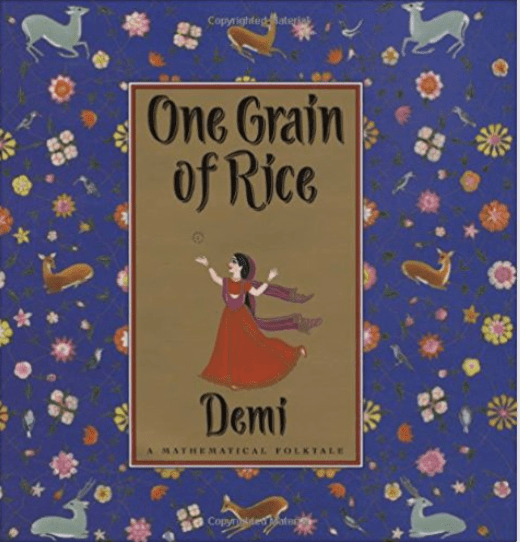
A Doubly Clever Folktale
Written and illustrated by Demi, picture book One Grain of Rice: A Mathematical Folktale is the author’s retelling of the Indian folktale “Sissa and the Troublesome Trifles.” Published in 1997 by Scholastic Press, this book for children ages 4-8 tells the story of an Indian raja who thought he was wise and fair by requiring those in his kingdom to give him most of their rice crop for safekeeping in the event of a famine. Well, when famine comes, he turns out to be not so fair after all, keeping all of the rice for himself until a clever girl Rani asks him, as a reward for a good deed she performed, for one grain of rice doubled for thirty days. Demi’s vibrantly colored and beautifully detailed illustrations show us just how much rice this amounts to for Rani and the hungry people she shares it with: over one billion grains of rice. An eye-catching gateway fold reveals that on the thirtieth day, the royal storehouses have been emptied on the backs of 256 elephants. The rich gold accents and engaging story will draw readers in for a read-aloud, but this text also makes an excellent curriculum support, a 30-day table on the book’s last page providing the numbers of grains of rice given to Rani on each day and an instruction to add these numbers together to get the grand total of 1,073,741,823 grains of rice. Readers of all ages will delight in this engaging tale of how one clever girl used math to feed the hungry and teach a ruler a lesson about compassion and fairness.

A Turtle With Feathers?
Written by Tim Tingle and illustrated by Stacey Schuett, picture book When Turtle Grew Feathers: A Folktale from the Chocktaw Nation is the Chocktaw telling of Aesop’s fable “The Tortoise and the Hare.” Published in 2007 by August House LittleFolk, this book for children ages 4-8 provides an explanation as to why you never see turtles and rabbits racing, for when Rabbit challenges Turtle to a race in this story, Rabbit is surprised to be beaten by Turkey, who had been trying on Turtle’s shell. Stacey Schuett’s acrylic paintings beautifully illustrate this story of friendship and provide the reader with charming depictions of the animal cast’s expressions, while Tim Tingle’s use of rhymed dialogue and onomatopoeia provide the sounds of the tale’s animals and help us to understand the value of humility. Not only does this story make an entertaining read-aloud for young readers, but it also has a place as curriculum support, the author’s source note at the end providing another point of reference for the study of Native American mythology. Children and their caregivers will enjoy this Choctaw tale, learning, as Tingle puts it, that “you don’t have to be the biggest, or the fastest, or the best. But it sure is nice to be friends with those that are!”
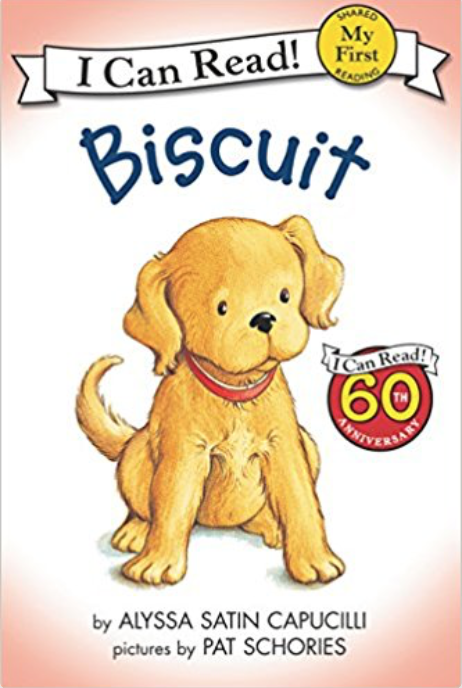
Bedtime for Biscuit
A HarperCollins My First I Can Read! easy reader, Biscuit is the story of a small, yellow dog who is reluctant to be put to bed by his little girl caretaker. Published in 1996, this book was written by Alyssa Satin Capucilli and illustrated by Pat Schories. Although no recommended age range is listed on this book, it seems best suited for 4-6 year olds who are just developing reading skills. It has plenty to help emergent readers along: lots of white space, short words and sentences, limited lines on a page, and a 24-point typeface. Repetition is also used effectively in this story: Biscuit’s “woof, woof!” is repeated on just about every spread following the small girl’s command of “Time for bed, Biscuit!”, helping young readers to anticipate what will happen next and learn to recognize these words. The warm, brightly-colored illustrations are charming, making this a perfect choice for a bedtime read aloud or an independent read. Children and caretakers alike will enjoy reading this sweet story of a dog who just wants one more story, kiss, snuggle… before bedtime.

Things That Go: Clackety-Clack
A National Geographic Level 1 easy reader, Trains by Amy Shields is a nonfiction text composed of episodic chapters full of facts about trains. Published in 2011, this book teaches its readers about such topics as types of trains and how they run, the history of trains in America, and train sounds The book contains no recommended reader age. Though the text is marked as a Level 1 reader, a ranking that most publishers use to orient these books toward beginning readers, this particular book would be best suited as an independent read for children who are beginning to develop confidence in their reading skills. The text provides lots of helpful features for early readers: large typeface, mostly short words and lines, Gary the Engineer’s additional information, “Train Talk” boxes defining words such as “loot” and “turntable,” and phonetic spellings for pronunciation of words like “maharaja” and “diesel.” Another fun feature of the text is the onomatopoeia: train sounds such as “whirrrrr,” clackety-clack,” “woooo-woo,” and “ding-ding-ding” are in different colorful fonts throughout the text, making this book a fun read-aloud option. However, early readers who are looking to read this book independently may find the layout visually overwhelming, as there is not much white space to speak of. The book is packed instead with color: photos both modern and historic, question and answer boxes, cartoon speech bubbles for Gary the Engineer. While these features are fun and interesting, they may not give an early reader’s eyes much chance to rest. This book would make a wonderful tool for classroom instruction or storytime, but is also a good choice for independent readers. Not only will this text delight train enthusiasts, but it will also interest children who had not previously been particularly interested in locomotives.

A Day at the Museum
A HarperCollins I Can Read! Level 1 easy reader, Fancy Nancy at the Museum is a charming story about Jane O’Connor (author) and Robin Preiss Glasser’s (illustrator) beloved character Fancy Nancy. In this particular adventure, illustrated by Ted Enik, Fancy Nancy is going on a class trip to an art museum but gets sick on the way after eating too large a lunch. Her teacher Ms. Glass, however, saves the day by loaning Nancy her extra sweater and beret (a French hat, as Fancy Nancy lets her readers know). This book is perfectly suited to its intended age range of ages 4-8 with a 22-point typeface, lots of white space, and short words and lines. While the fun, colorful illustrations will please fans of the Fancy Nancy series, the best feature of this book is the way it manages to teach its readers new words, such as “overjoyed,” “merci,” and “spectacular,” through parenthetical asides that feel almost conspiratorial between Nancy and her reader, explaining that these words are “fancy words” for “very happy,” “French for ‘thank you,’ ” and “great.” The text also manages to teach new words about its setting, the museum, defining such words as “gallery,” “landscapes,” “still lifes,” and “portraits” by weaving them into the story without disrupting it. A glossary of “Fancy Nancy’s Fancy Words” with pronunciation help for the French words is provided at the end of the book to recap for the reader. This book makes a wonderful classroom supplement, especially for an art class, but also is an enjoyable independent read. While this story is clearly aimed at little girls with its fancy title character and her other female friends, including her teacher, boys have something to learn from this text, too, about art and the art of being considerate.
 The Mermaid's Tale