Posted in Book Reviews

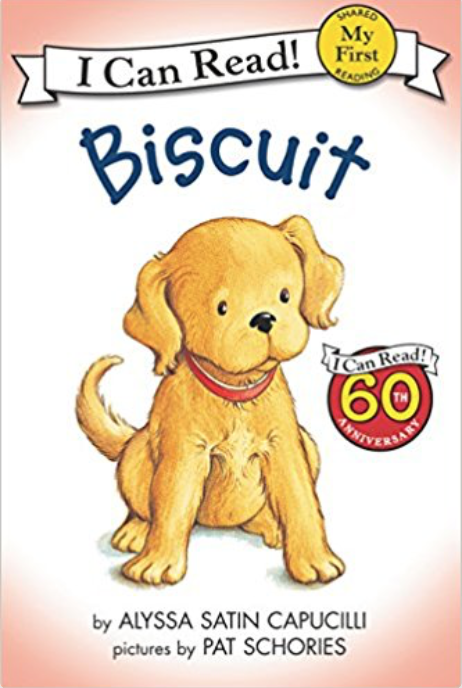
Bedtime for Biscuit

A HarperCollins My First I Can Read! easy reader, Biscuit is the story of a small, yellow dog who is reluctant to be put to bed by his little girl caretaker.  Published in 1996, this book was written by Alyssa Satin Capucilli and illustrated by Pat Schories. Although no recommended age range is listed on this book, it seems best suited for 4-6 year olds who are just developing reading skills.  It has plenty to help emergent readers along: lots of white space, short words and sentences, limited lines on a page, and a 24-point typeface. Repetition is also used effectively in this story: Biscuit’s “woof, woof!” is repeated on just about every spread following the small girl’s command of “Time for bed, Biscuit!”, helping young readers to anticipate what will happen next and learn to recognize these words.  The warm, brightly-colored illustrations are charming, making this a perfect choice for a bedtime read aloud or an independent read. Children and caretakers alike will enjoy reading this sweet story of a dog who just wants one more story, kiss, snuggle… before bedtime.

Posted in Book Reviews

Things That Go: Clackety-Clack

A National Geographic Level 1 easy reader, Trains by Amy Shields is a nonfiction text composed of episodic chapters full of facts about trains.  Published in 2011, this book teaches its readers about such topics as types of trains and how they run, the history of trains in America, and train sounds  The book contains no recommended reader age. Though the text is marked as a Level 1 reader, a ranking that most publishers use to orient these books toward beginning readers, this particular book would be best suited as an independent read for children who are beginning to develop confidence in their reading skills.  The text provides lots of helpful features for early readers: large typeface, mostly short words and lines, Gary the Engineer’s additional information, “Train Talk” boxes defining words such as “loot” and “turntable,” and phonetic spellings for pronunciation of words like “maharaja” and “diesel.” Another fun feature of the text is the onomatopoeia: train sounds such as “whirrrrr,” clackety-clack,” “woooo-woo,” and “ding-ding-ding” are in different colorful fonts throughout the text, making this book a fun read-aloud option.  However, early readers who are looking to read this book independently may find the layout visually overwhelming, as there is not much white space to speak of. The book is packed instead with color: photos both modern and historic, question and answer boxes, cartoon speech bubbles for Gary the Engineer. While these features are fun and interesting, they may not give an early reader’s eyes much chance to rest. This book would make a wonderful tool for classroom instruction or storytime, but is also a good choice for independent readers.  Not only will this text delight train enthusiasts, but it will also interest children who had not previously been particularly interested in locomotives.

Posted in Book Reviews

A Day at the Museum

A HarperCollins I Can Read! Level 1 easy reader, Fancy Nancy at the Museum is a charming story about Jane O’Connor (author) and Robin Preiss Glasser’s (illustrator) beloved character Fancy Nancy.  In this particular adventure, illustrated by Ted Enik, Fancy Nancy is going on a class trip to an art museum but gets sick on the way after eating too large a lunch.  Her teacher Ms. Glass, however, saves the day by loaning Nancy her extra sweater and beret (a French hat, as Fancy Nancy lets her readers know). This book is perfectly suited to its intended age range of ages 4-8 with a 22-point typeface, lots of white space, and short words and lines.  While the fun, colorful illustrations will please fans of the Fancy Nancy series, the best feature of this book is the way it manages to teach its readers new words, such as “overjoyed,” “merci,” and “spectacular,” through parenthetical asides that feel almost conspiratorial between Nancy and her reader, explaining that these words are “fancy words” for “very happy,” “French for ‘thank you,’ ” and “great.”  The text also manages to teach new words about its setting, the museum, defining such words as “gallery,” “landscapes,” “still lifes,” and “portraits” by weaving them into the story without disrupting it. A glossary of “Fancy Nancy’s Fancy Words” with pronunciation help for the French words is provided at the end of the book to recap for the reader.  This book makes a wonderful classroom supplement, especially for an art class, but also is an enjoyable independent read. While this story is clearly aimed at little girls with its fancy title character and her other female friends, including her teacher, boys have something to learn from this text, too, about art and the art of being considerate.

Posted in Book Reviews

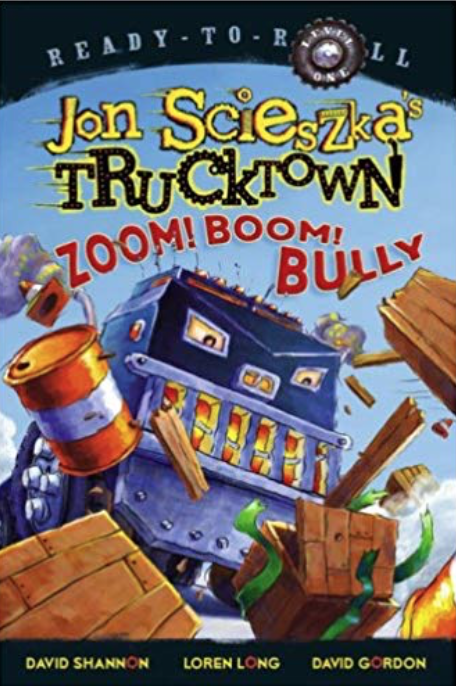
A Bully’s Birthday

An Aladdin Paperbacks Ready-To-Roll Level 1 easy reader, Jon Scieszka’s Trucktown: Zoom! Boom! Bully is the story of the efforts of five little trucks who do something kind for Big Rig the bully’s birthday by giving him a gift to zoom! boom! knock over.  Published in 2008, this story is written by Jon Scieszka with artwork created by David Shannon, Loren Long, and David Gordon of the Design Garage. Similar to other publishers’ level 1 texts, this book uses short words and sentences, a large typeface, and white space to encourage early readers.  The larger, colorful text for the onomatopoeia Zoom! Boom! adds variety and interest. The text also offers a review of counting backward from four to one as the trucks build Big Rig a layered “cake” of barrels, crates, tires, and cement icing. The repetition of “Zoom! Boom!”, “Big Rig!”, and “He is such a bully,” will also help young readers along.  The artwork is colorful and engaging, effectively conveying Big Rig’s angry Zoom! Boom! and the other trucks’ looks of disappointment at his bullying. Though this book seems to be aimed at little boys, the presence of the pink garbage truck Gabby may seek to draw girls’ attention, as well. This book would make a fun independent read or a read aloud for children who enjoy reading about things that go.  

Posted in Book Reviews

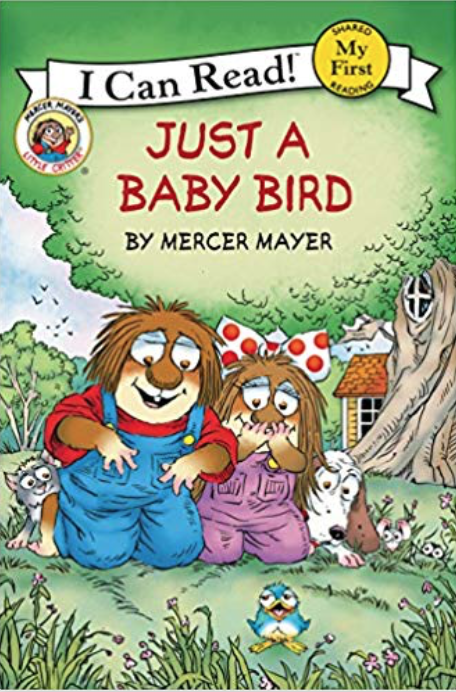
Caring for a Baby Bird

A HarperCollins My First I Can Read! easy reader, Just a Baby Bird by Mercer Mayer is another adventure of the Little Critter and his family.  In this story for children ages 4-8 who are learning to read with help, Little Critter and his sister discover a baby bird whose momma is nowhere to be found.  The family takes care of the bird until it is time for it to fly away, but the bird returns in the spring with a family of its own. Published in 2016, this story is told in an accessible manner for emergent readers with short words and lines, a 24-point typeface, and plenty of white space.  The brightly-colored illustrations help to communicate the story and will be familiar to fans of the Little Critter series, while the modern touches of Mom looking up what to feed the baby bird online and Dad using his smartphone to take a picture of it add modern elements that children will recognize.  Children will enjoy reading this story of compassion and patience on their own or experiencing it as a read aloud.

Posted in Book Reviews

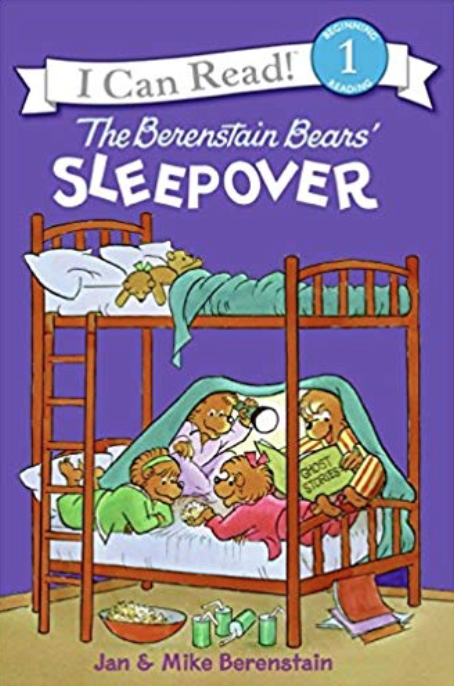
(Sleep?)over

A HarperCollins I Can Read! Level 1 easy reader, The Berenstain Bears’ Sleepover by Mike and Jan Berenstain is another tale of the beloved Berenstain Bear family’s adventures.  In this story for children ages 4-8 who are just beginning to read, Sister and Brother Bear have a sleepover with some friends, but not much sleep actually occurs, resulting in a sleepy Papa and Mama Bear the next morning.  Published in 2009, this story is told in an accessible manner for beginning readers with short words and lines, a 22-point typeface, and plenty of white space. The brightly-colored illustrations help to communicate the story and will be familiar to fans of the Berenstain Bears series.  One thing of note, while the word and line length in this book are not excessive for this beginning reading stage, the sentence length is at times a tad long, with sentences frequently composed of 10 words or more, and there are several lines on each page.  The sentences are simple and declarative, so the complexity should not be prohibitive, but they are longer and more plentiful than sentences found in other I Can Read Level 1 easy readers, a fact for caretakers to be aware of if recommending this book to be read independently by readers truly just beginning to read.  Being too excited to sleep is surely an experience that both children and adults can relate to, making this story a fun read-aloud or an enjoyable book for a child to read on her own.