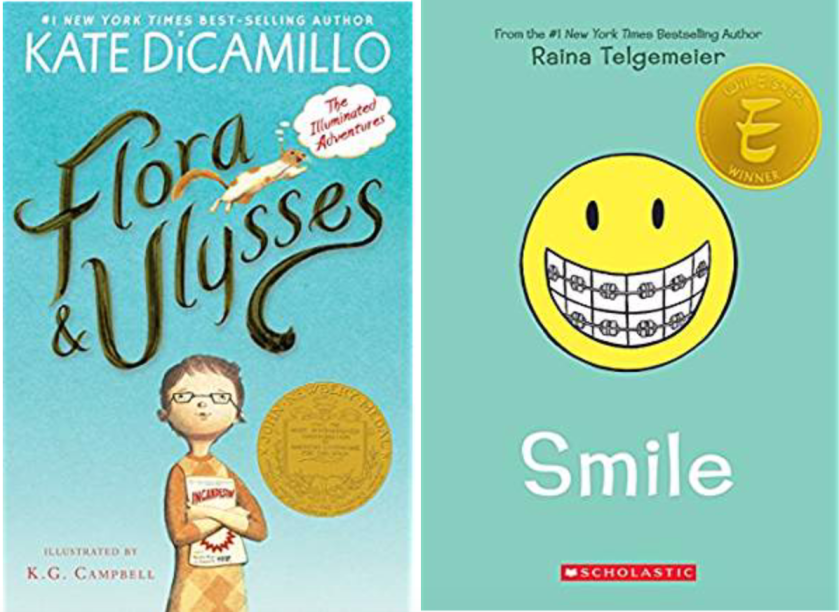
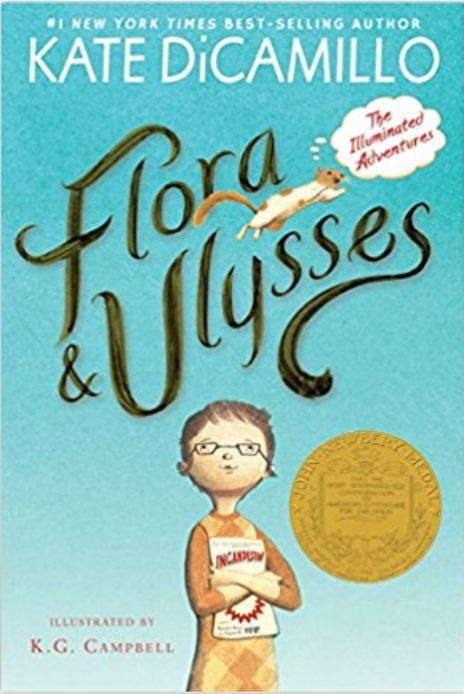
Plan 1: Intergenerational Public Library Fantasy Book Club using Flora & Ulysses
Much of the credit for my love for reading goes to my parents, my mother especially. Hours were spent on my mother’s lap reading stories. I distinctly remember seeing her reading regularly. We have regular conversations about what we are reading. Her involvement in my reading life has shaped my life as a reader. Now, as a children’s librarian, it is one of my greatest joys to watch children sit on their parents’ laps and pore over books they’ve found on the shelves. In order to keep those conversations about books going, I’d like to form a multigenerational book club centered around Flora & Ulysses. In this story, Flora’s relationship with her divorced parents is central to the plot and theme of the story, and I’d like to use this as a platform for parents/caregivers and kids to discuss a book together and think about and build their relationships to one another.
This book club, which will involve the creation of the participants’ own fantasy stories, will be for middle-school-age children and a parent or caregiver. It will meet once a week for five weeks. Each meeting will be an hour long, and snacks will be served. I will publicize it with fliers in the library, a feature on my library bulletin board and on our library website, and posts to our library’s Facebook account. Registration will be required, and the group will be capped at 15 pairs of students and parents/caregivers (30 people total). Our library has one physical copy of the book and three ebooks. The rest of the titles can be obtained through JerseyCat, our interlibrary loan service. The budget is $150 for snacks for the meetings. Our library already has all of the art supplies our group will need.
During the first week, I’ll hand out Flora & Ulysses to the book club members and explain the accompanying activities for the month: reading the book and creating our own fantasy stories. We’ll discuss what the members think of when they think of fantasy stories, whether they enjoy them or not, and what the fantasy genre encompasses. We’ll also discuss the differences between high and low fantasy. I’ll remind the club members that we’ll come back to this discussion of fantasy as we make our way through the book. To conclude this first meeting, we’ll begin reading the book out loud together. We’ll look at Campbell’s illustrations and will proceed through the first chapter readers’ theater-style, with a middle schooler reading Flora’s words and thoughts, one of the moms reading Flora’s mother, and me reading the narration. I’ll ask the club members to read the first 22 chapters for next week.
For the second meeting, I’ll ask the book club members what they think so far of the characters and Flora’s world. What do they think of Flora’s relationship with her parents? How do they think Flora’s parents really feel about her? What does Flora think that her parents think of her? What do the book club members think of Campbell’s illustrations and how they’re used in the text? After discussing, I’ll introduce the activity for the week: beginning our own fantasy stories. Club members can write their stories in text and make a print book; they can make a graphic novel (we’ll pay special attention to how Campbell’s illustrations function in the text) in print or with Toondoo; or they can use Storybird. I’ll offer a tutorial for using the websites for those who are interested in those options. I’ll also provide art supplies for those interested in making a print book. Each student will write their fantasy story with their parent/caregiver who is attending the book club with them. A central theme of this novel is love and belonging. Flora is looking for it in this story, and how she sees her parents affects her sense of home. I’d like the book club members to think about these relationships in their own lives and represent them in their stories. During this week’s session, each pair will sketch out some preliminary ideas for their stories. Will they use a high or low fantasy format? What will the world of the story be like? What kinds of characters will they include? Club members should work on drafting some ideas for next week and should read chapters 23-45.
For the third meeting, we’ll discuss how things are progressing in the story. What is happening with Flora and her parents? What about Flora’s other relationships? What is everyone thinking about Campbell’s illustrations? What does everyone think about Ulysses? Is there something special about him? Why is Flora so attached to him? What is everyone noticing about the significance of words to Flora and Ulysses? Why does she repeat the phrases she does? Also during this week’s meeting, everyone will add to their fantasy stories. I’ll discuss the basic elements of plot and encourage everyone to think about how these points will be represented in their stories. Club members should continue drafting their stories for next week and should read chapters 46-68 and the Epilogue, finishing the story.
For the fourth meeting, we’ll discuss the ending of the novel. What does everyone think about how DiCamillo tied everything together at the end? Do they find it believable? Satisfying? What do Flora and her parents learn? Does everyone have a favorite character? What did everyone think of Campbell’s illustrations? In addition to discussing the novel, book club members will work on finishing their stories. I’ll encourage everyone to think about the power and significance of words for Flora and Ulysses. With this in mind, book club members can consider revising their word choices, adding poetry, or using repetition.
For the fifth and final meeting, book club members will share their stories with each other. To celebrate the completion of our works, we’ll have a pizza party and giant donuts, with sprinkles a lá Flora and Ulysses, during our meeting. With the book club members’ permission, I will display the print books in the library on a themed display. I will also curate the digital books on Symbaloo and will share the link on our library’s website and in a library Facebook post for the larger library community to view.
Plan 2: Graphic Novel Memoirs School Library Plan
These past few weeks, I have been really intrigued and delighted by the graphic novel nonfiction scene, so that has been my inspiration for this Culture of Literacy plan. This plan is for a school library, though I think it could work equally well in a public library. When I was teaching high school English, one of my greatest challenges (but sometimes also my most joyful moments) was finding ways to connect with the myriad of international students in my classes. By the time the students got to me in senior English, they were supposed to have tested out of ELL classes, but this wasn’t always the case. More often than not, many of the students’ language skills were not advanced enough to keep up in a classroom studying British Literature, so I was always looking for ways to connect these students to the other native-English-speaking students and to engage the ELL students with the content and skills in a way that made the material more accessible. This plan is for them.
I envision this plan, which I’m calling Sharing My Story, being put into action in a middle school library, the librarian working with the ELL teachers to facilitate those students’ learning and engagement. The librarian will also be working with the 6th grade Language Arts teachers and their students, as they’ll be participating in this unit as well. During the unit, students will read a graphic novel and will create their own graphic novel memoirs based on their own experiences. This unit will support the following Common Core standard for writing for 6th grade: “CCSS.ELA-LITERACY.W.6.3–Write narratives to develop real or imagined experiences or events using effective technique, relevant descriptive details, and well-structured event sequences.” The unit will take place during the month of October to coincide with National Graphic Novel Writing Month and to help the students start the school year off in a successful way. Ideally, this unit’s ELL participants would be taught to students who are new to the school and at the beginning of their international studies. I will conduct the first meetings with ELL students and regular Language Arts students separately to give each group a chance to get comfortable with me and with the material. After this, the meetings will be together, if scheduling allows.
During the first meeting of the unit, sixth grade ELL students will meet in the library with me, the school library media specialist, to be introduced to graphic novels, specifically graphic novel memoirs. I will first ask the students to create a series of three pictures that describe their experience so far with studying in this new school and country. They may use paper and colored pencils/markers/ink or they may collage their images from provided materials. After the students have composed their images, I will ask the kids to add words to each picture. If the students aren’t comfortable sharing their drawings with the group, they can choose a partner with whom they can share and discuss their work. Upon completion of this activity, I will explain that we will be spending the month reading and working on the students’ own graphic novel memoirs. I’ll booktalk El Deafo, Smile, Sisters, Real Friends, and To Dance: A Ballerina’s Graphic Novel as the choices for students to read and will assist them with checking one of those titles out. I’ll ask them to read the first 50 pages or so of their chosen book for our next meeting later in the week.
During the second meeting, we’ll discuss what students are reading, and I’ll explain the project: we’ll be writing our own graphic novel memoirs, consisting of at least eight spreads (I’ll be making one too so the students can get to know me a little better). At the end of the unit, we’ll have a party with the students’ families and host families to view our books. Students and their families will be asked to bring one snack to share that represents their home country. Students may choose to depict their experience with coming to the U.S., or they can choose an event or time period from their lives at home. They may make their own physical book, or they may use Photoshop or ToonDoo to create a digital book. I will provide art supplies, including materials to create collage art, for those wanting to make a physical book, and I’ll provide instruction for those wishing to make a digital product. Additionally, I’ll introduce students to reference books in our library which may be of use to them in this unit: Understanding Comics by Scott McCloud, Ed Emberley’s Drawing Book series, and Writing with Pictures by Uri Shulevitz. By the end of this meeting, we’ll decide what event or time period our graphic novels will be about. Since I’ll be making one too, I’ll model brainstorming ideas with a web graphic organizer on the board. I’ll give the students their own graphic organizers to brainstorm their ideas and decide upon their book’s topics. I’ll ask the students to read the next 50 pages of their chosen graphic novels for our next meeting the following week. I’ll also send an email home to the students’ families and host families explaining our project and encouraging them to read the same graphic novel that their students chose so that they can converse about it at home.
During our third meeting in the unit’s second week, we’ll discuss what students are reading, specifically how the artwork communicates things to them that the text alone does not. We’ll also continue working on our books by creating a storyboard. We’ll do this on paper with a graphic organizer so that the kids can visualize their spreads, deciding upon what artwork and text will go on each page. I’ll ask the students to read the next 50 pages of their chosen graphic novels and to finish their storyboards for our next meeting that week.
During our fourth meeting, we’ll discuss what students are reading, continuing to focus on how the artwork and text work together and on how the stories are developing. I’ll conference with each of them about their storyboards as they begin to work on building their books. I’ll ask the students to finish their reading of their chosen graphic novels and to complete at least two spreads of their book for our next meeting the following week.
During our fifth meeting in the unit’s third week, we’ll discuss the conclusions of the students’ readings. What did they think about the way the authors chose to tell their stories? We’ll spend the rest of our time on our books. I’ll show the kids what I have so far and will meet with each of them briefly to see how their books are developing. I’ll ask them to complete another two spreads of their book for our next meeting that week.
During our sixth meeting, we’ll continue to work on our books. Their next two spreads will be due the following week.
During our seventh meeting in the unit’s fourth week, we’ll continue to work on our books. I’ll share some of my progress and will offer feedback on their work. Their last two spreads will be due at our next meeting that week.
During our eighth meeting, we will put the finishing touches on our books. I’ll remind that for our meeting next week, their host families will be joining us in the library to view our graphic memoirs.
During our ninth meeting and the final one of the unit, we will have a party in the library to celebrate and view our projects. We will have the food that I and the students and their families brought from their home traditions and countries. If students feel comfortable with it, I will share their books digitally on the library’s web page or display their books in the library. I’ll invite the school community to view and comment on them. However, I understand that some of them may feel that their books are too personal, so I will only display the books from students who give me permission. Hopefully, this will be an opportunity for students and their host families to bond and for the hosts to gain a better understanding of the student who is spending the year with them. I also hope that this will be an opportunity for students to bond with each other and to understand those with different experiences and cultures than their own. If students allow me to share, the opportunity for understanding and building relationships can be expanded to the school community, as well.
 The Mermaid's Tale