
Tag: nonfiction
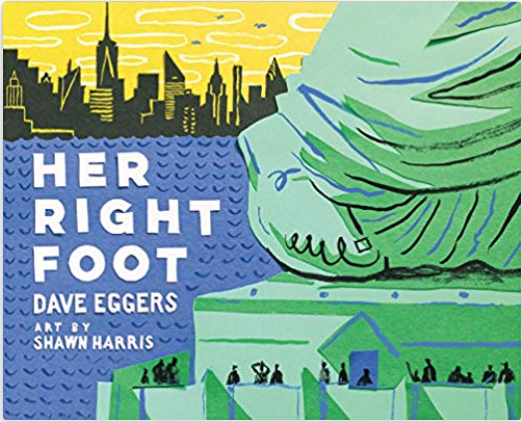
Lady Liberty Is On The Move!
Nonfiction picture book Her Right Foot, written by Dave Eggers and illustrated by Shawn Harris, is a thought-provoking look at a symbol we all recognize: the Statue of Liberty. Eggers, however, does not focus on her face or her torch as he points out that most representations or discussions of her do, but at her right foot, which is mid-stride. Published in 2017 by Chronicle Books, this picture book’s intended audience is children in kindergarten-3rd grade, but the information it presents–who built the statue and where, how it was constructed, what various parts of her represent–may be new to the adult readers of this story as well. Eggers’ notice of the fact that “She is on the move!” spurred him to write this book, asking his readers in a dry, conversational tone to think about the fact that this iconic American symbol of welcome is moving. His theory, vibrantly illustrated by Harris, is that she, herself an immigrant, must continue to meet immigrants “in the sea” rather than standing still and waiting for change. Photos of the statue, as well as a photo of “The New Colossus” sonnet at her base, accompany Eggers’ source notes and suggestions for further reading, making this book one to read to our children, to our friends, to our neighbors to spur thought and conversations around this timely topic.
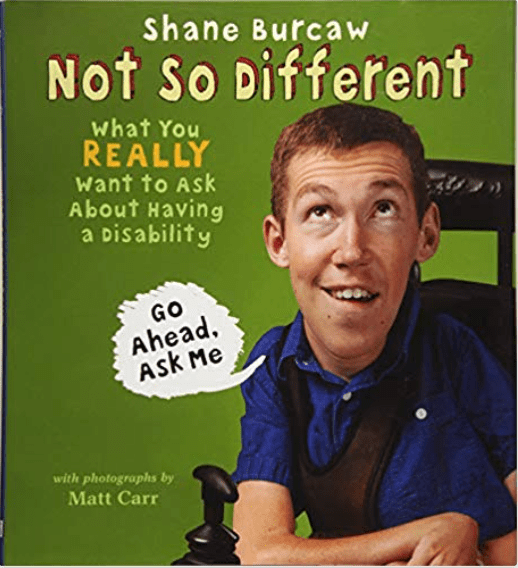
Shane Burcaw Is Not So Different
Nonfiction picture book Not So Different: What You Really Want to Ask About Having a Disability by Shane Burcaw is one that answers questions that the author has encountered about his disability, a disease called spinal muscular atrophy (SMA). Published in 2017 by Roaring Brook Press, the book is formatted with Matt Carr’s colorful photographs of Burcaw and his family interspersed with graphics and speech bubbles, making it accessible not only to its intended audience of students in 1st-4th grades, but to readers of all ages. Questions ranging from “What’s wrong with you?” to “Do people ever make fun of you?” are answered honestly and humorously by Burcaw, addressing topics just about everyone has wondered about those with disabilities and helping readers to see that Burcaw is not so different than them. He informs us that he likes foods like mashed potatoes, mac and cheese, and pizza, sometimes “all at once.” He drives his chair with “a joystick, sort of like a video-game controller.” His author’s note reminds us that “we all have different strengths, weaknesses, and abilities, and that’s not just okay, it’s beautiful.” This book is a wonderful resource to share with children as we seek to educate them about not only those with disabilities, but also about what makes each of us unique and about the ways in which we are all similar.
Tell Me A Story: A World War I Nonfiction Unit Plan
As one previously guilty of the heavy bent toward fiction, a couple of years ago, I realized that I needed to incorporate more nonfiction reading (especially primary source) into my unit plans in my high school English classroom. I also wanted to enable students to see the connections between people and periods they were learning about in their history classes with works of fiction we were reading in English. So, I rewrote the high school English curriculum to align with history classes, so that if students were learning about World War I in history, they were reading All Quiet On the Western Front in English, along with Wilfred Owen’s poems “Dulce Et Decorum Est” and “Anthem for Doomed Youth” and various works of nonfiction like primary source speeches, newspaper articles, and biographical pieces. Thinking about this culture of literacy discussion this week has made me continue to think about ways to incorporate nonfiction into school curriculums. As a school media specialist, this is something I would not only advocate for, but actively participate in, providing teachers with recommended titles to incorporate into their lessons, whatever the topic or subject may be.
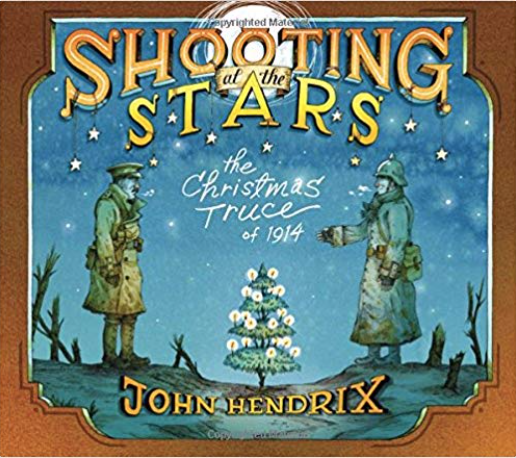
My plan this week is for a school library serving high school students. This unit “Tell Me A Story” would be taught over the course of six weeks in conjunction with the 9th grade English and history teachers’ World War I unit. During the students’ first day of the unit in the library, I will read to them both Shooting at the Stars and Finding Winnie. The former tells the story of the Christmas truce of 1914, an event which, although denied by military officials, is described in several soldiers’ letters home. John Hendrix explains the source of the story, even including a photo of Allied and German soldiers together, in his author’s note. It is a blend of fact and fiction as Hendrix tells the tale from the first-person perspective of a young British soldier writing a letter home to his mother, weaving together background historical information, hand-lettered text, illustrations, and a photograph. Finding Winnie is the true story of the bear who inspired A.A. Milne’s beloved Winnie the Pooh. It’s a story lovingly told by the great-granddaughter of the man who originally found the bear, Harry Colebourne. Lindsay Mattick frames the story as a bedtime story for her son, Cole, and decides, along with illustrator Sophie Blackall, to include a family album in the book, a wonderful addition of photos, diary pages, and a 1914 London Zoo animal record. Both Finding Winnie and Shooting at the Stars inform readers about specific aspects of World War I and the people involved in a way that incorporates carefully researched text with illustrations and primary source material. Students will use these books as inspiration for their own books they’ll be making using Book Creator as a part of this unit. The books must include text, illustrations in whatever medium students choose, audio/visual material, and primary source material. The way they integrate these elements is up to them. They can compose the book as a story the way Mattick or Hendrix did, or students can make a scrapbook.
During the first and second weeks of the unit, I will help students locate print and digital resources in the library so they can read about World War I and decide about what aspect of it they’d like to write their book. I will provide instruction about using the Dewey Decimal system, databases, Google, and Wikipedia effectively.
During the third week of the unit, I will teach students how to use easybib.com to cite the sources they have decided to use. Also, during this week, students will decide upon the design of their book and what information they will be using in it.
During the fourth and fifth weeks of the unit, students will write and create their books on Book Creator. I will teach students learn how to use the platform as well as help them with any issues they may run into as they write their books.
During the sixth and final week of the unit, students will present their books to each other, and I will curate them on our library’s website so that the school community can enjoy reading them.
Things That Go: Clackety-Clack
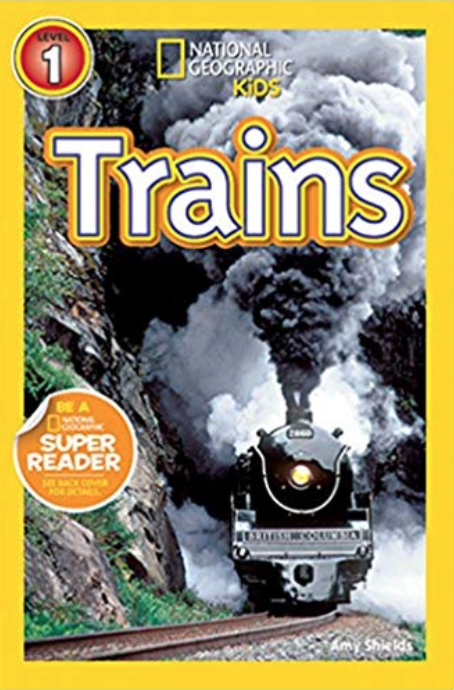
A National Geographic Level 1 easy reader, Trains by Amy Shields is a nonfiction text composed of episodic chapters full of facts about trains. Published in 2011, this book teaches its readers about such topics as types of trains and how they run, the history of trains in America, and train sounds The book contains no recommended reader age. Though the text is marked as a Level 1 reader, a ranking that most publishers use to orient these books toward beginning readers, this particular book would be best suited as an independent read for children who are beginning to develop confidence in their reading skills. The text provides lots of helpful features for early readers: large typeface, mostly short words and lines, Gary the Engineer’s additional information, “Train Talk” boxes defining words such as “loot” and “turntable,” and phonetic spellings for pronunciation of words like “maharaja” and “diesel.” Another fun feature of the text is the onomatopoeia: train sounds such as “whirrrrr,” clackety-clack,” “woooo-woo,” and “ding-ding-ding” are in different colorful fonts throughout the text, making this book a fun read-aloud option. However, early readers who are looking to read this book independently may find the layout visually overwhelming, as there is not much white space to speak of. The book is packed instead with color: photos both modern and historic, question and answer boxes, cartoon speech bubbles for Gary the Engineer. While these features are fun and interesting, they may not give an early reader’s eyes much chance to rest. This book would make a wonderful tool for classroom instruction or storytime, but is also a good choice for independent readers. Not only will this text delight train enthusiasts, but it will also interest children who had not previously been particularly interested in locomotives.
 The Mermaid's Tale