Posted in Storytime Plans by Theme

Earth Day Storytime

6aa67690-d194-405d-8555-d0478825f0b0-1

Earth Day is today, April 22, and it made for a fun storytime theme last week with stories, songs, and a craft.

We started the way we always do with our library storytime songs “The More We Read Together” and “If You’re Ready for a Story.” The kids wiggle their fingers and stomp their feet slowly for the first round of “The More We Read Together”, then wiggle and stomp and sing a little faster for the second round, then even faster for the third round before taking a deep breath and singing “If You’re Ready for a Story.” The lyrics are as follows:

The More We Read Together” (Tune: “The More We Get Together”)

The more we read together, together, together,

The more we read together, at the library, 

Where your books (point to others) are my books (point to self),

And my books (point to self) are your books (point to others),

The more we read together the happier we’ll be!

If You’re Ready for a Story” (Tune: “If You’re Happy and You Know It”)

If you’re ready for a story take a seat,

If you’re ready for a story take a seat,

Clap your hands and stomp your feet,

Make your hands all nice and neat,

If you’re ready for a story, take a seat!

We always start our first story after everyone is all settled on their cushions. For Earth Day Storytime, that story was Love, The Earth, written by Frances Stickley and illustrated by Tim Hopgood. I enjoyed seeing one little girl’s face light up when she saw the polar bears in the book!

We took a break after this book to sing “E-A-R-T-H” to the tune of “B-I-N-G-O.” Thanks to the creators at https://www.theholidayzone.com/earth/songs.html for the idea!

“E-A-R-T-H” (Tune: “B-I-N-G-O”)

There is a planet we call home

And “Earth” is its name.

E-A-R-T-H

E-A-R-T-H

E-A-R-T-H

And Earth is its name.

We must all work to care for her,

To keep her safe and clean —

C-L-E-A-N

C-L-E-A-N

C-L-E-A-N

This planet we call home. 

This song was followed by our next book, The Earth Book by Todd Parr. The vibrant illustrations and simple text are perfect for storytime’s little listeners. Also, this book was enhanced by a lovely soundscape provided by Novel Effect, an app that uses voice isolation technology to listen to your voice and play corresponding music and sound effects for the text. More on this app in another post, but to make a long story short, I’m thrilled my library director agreed this year to purchase a public library subscription for our patrons to use!

After this story, it was time for a song break complete with instruments for the storytime friends to play. For Earth Day Storytime, we used “The Goldfish” by The Laurie Berkner Band (one of my storytime favorites!) and “This Land Is Your Land” by Cooltime Kids.

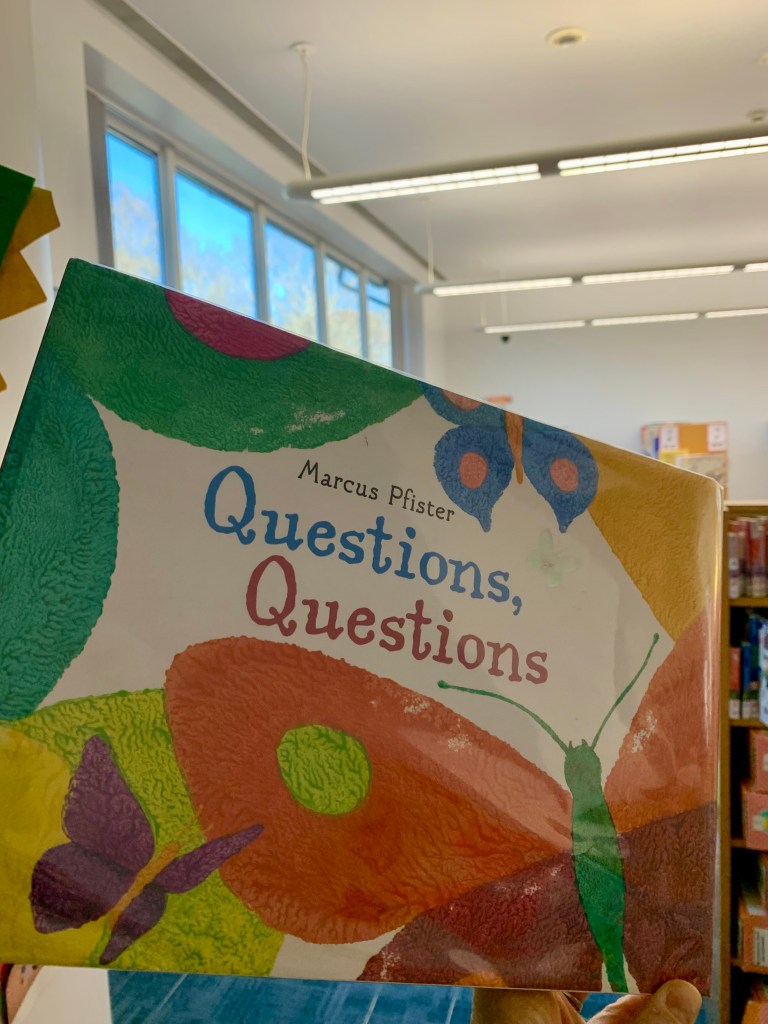
The book Questions, Questions by Marcus Pfister was our next read after everyone helped clean up the instruments and found their cushions again. I love the wonderment at God’s amazing design for the Earth that this book conveys without being overtly spiritual in its language.
Our next song break was “If You Really Love the Earth” sung to the tune of “If You’re Happy and You Know It.” Thanks to Eric at PreschoolEducation.com for compiling a great list of Earth Day Songs for Preschoolers. Find it here https://preschooleducation.com/searth.shtml

“If You Really Love the Earth” (Tune: “If You’re Happy and You Know It”)

If you really love the Earth, clap your hands.

If you really love the Earth, clap your hands.

If you really love the Earth, love it for all its worth,

If you really love the Earth, clap your hands.

Other Verses:

…plant new trees

…then recycle

…turn off the light

…stop the drip

Our last story, again with Novel Effect soundscape, was Brendan Wenzel’s A Stone Sat Still. The soothing sounds were a perfect complement to the beautiful muted colors of Wenzel’s illustrations of all the purposes a stone can serve in nature.

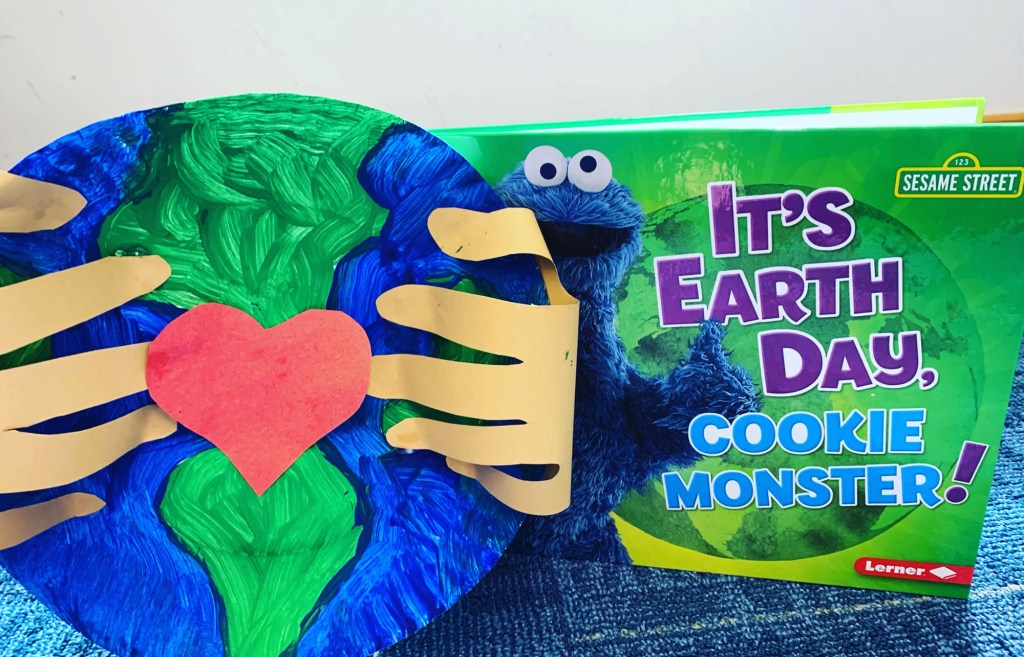
We wrapped up our storytime with a craft, idea courtesy of The Simple Parent. Find the idea here https://thesimpleparent.com/earth-day-craft-preschoolers-will-love/?utm_medium=social&utm_source=pinterest&utm_campaign=tailwind_tribes&utm_content=tribes&utm_term=566987976_20943222_148584 I prepped the tan construction paper ahead of time into squares for the kids to trace their hands on and cut them out. I also provided red paper hearts, white paper plates, glue sticks, and green and blue paint sticks. These work beautifully for painting projects as they are used like crayons but cover like paint.

Overall, we had a great time celebrating the beauty of our planet and how we can help to preserve it.

“I take care of the earth because I know I can do little things every day to make a BIG difference.” – Todd Parr, The Earth Book
Posted in Book Reviews

Lady Liberty Is On The Move!

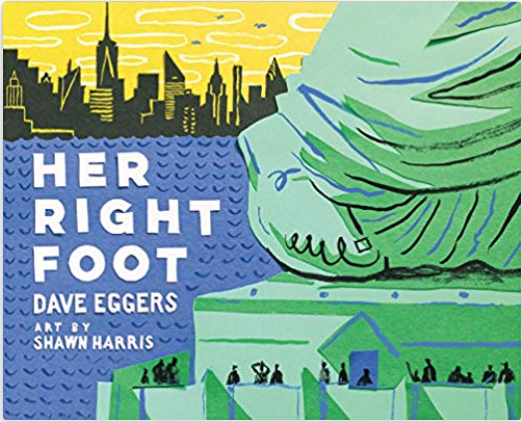
Nonfiction picture book Her Right Foot, written by Dave Eggers and illustrated by Shawn Harris, is a thought-provoking look at a symbol we all recognize: the Statue of Liberty.  Eggers, however, does not focus on her face or her torch as he points out that most representations or discussions of her do, but at her right foot, which is mid-stride.  Published in 2017 by Chronicle Books, this picture book’s intended audience is children in kindergarten-3rd grade, but the information it presents–who built the statue and where, how it was constructed, what various parts of her represent–may be new to the adult readers of this story as well.  Eggers’ notice of the fact that “She is on the move!” spurred him to write this book, asking his readers in a dry, conversational tone to think about the fact that this iconic American symbol of welcome is moving. His theory, vibrantly illustrated by Harris, is that she, herself an immigrant, must continue to meet immigrants “in the sea” rather than standing still and waiting for change.  Photos of the statue, as well as a photo of “The New Colossus” sonnet at her base, accompany Eggers’ source notes and suggestions for further reading, making this book one to read to our children, to our friends, to our neighbors to spur thought and conversations around this timely topic.

Posted in Book Reviews

Shane Burcaw Is Not So Different

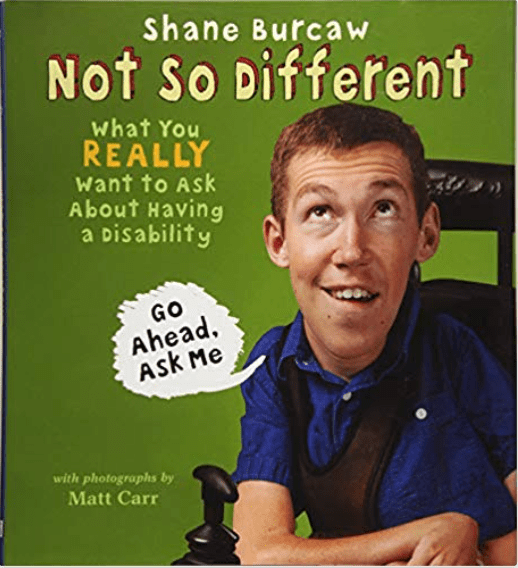
Nonfiction picture book Not So Different: What You Really Want to Ask About Having a Disability by Shane Burcaw is one that answers questions that the author has encountered about his disability, a disease called spinal muscular atrophy (SMA).  Published in 2017 by Roaring Brook Press, the book is formatted with Matt Carr’s colorful photographs of Burcaw and his family interspersed with graphics and speech bubbles, making it accessible not only to its intended audience of students in 1st-4th grades, but to readers of all ages.  Questions ranging from “What’s wrong with you?” to “Do people ever make fun of you?” are answered honestly and humorously by Burcaw, addressing topics just about everyone has wondered about those with disabilities and helping readers to see that Burcaw is not so different than them. He informs us that he likes foods like mashed potatoes, mac and cheese, and pizza, sometimes “all at once.”  He drives his chair with “a joystick, sort of like a video-game controller.” His author’s note reminds us that “we all have different strengths, weaknesses, and abilities, and that’s not just okay, it’s beautiful.” This book is a wonderful resource to share with children as we seek to educate them about not only those with disabilities, but also about what makes each of us unique and about the ways in which we are all similar.  

Posted in Book Reviews

A Doubly Clever Folktale

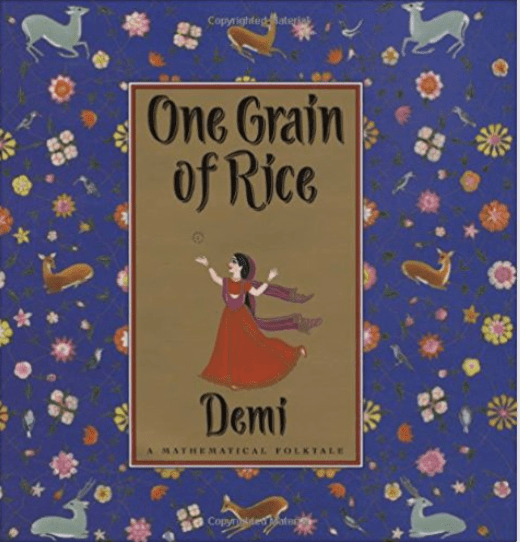
Written and illustrated by Demi, picture book One Grain of Rice: A Mathematical Folktale is the author’s retelling of the Indian folktale “Sissa and the Troublesome Trifles.”  Published in 1997 by Scholastic Press, this book for children ages 4-8 tells the story of an Indian raja who thought he was wise and fair by requiring those in his kingdom to give him most of their rice crop for safekeeping in the event of a famine.  Well, when famine comes, he turns out to be not so fair after all, keeping all of the rice for himself until a clever girl Rani asks him, as a reward for a good deed she performed, for one grain of rice doubled for thirty days. Demi’s vibrantly colored and beautifully detailed illustrations show us just how much rice this amounts to for Rani and the hungry people she shares it with: over one billion grains of rice.  An eye-catching gateway fold reveals that on the thirtieth day, the royal storehouses have been emptied on the backs of 256 elephants. The rich gold accents and engaging story will draw readers in for a read-aloud, but this text also makes an excellent curriculum support, a 30-day table on the book’s last page providing the numbers of grains of rice given to Rani on each day and an instruction to add these numbers together to get the grand total of 1,073,741,823 grains of rice.  Readers of all ages will delight in this engaging tale of how one clever girl used math to feed the hungry and teach a ruler a lesson about compassion and fairness.

Posted in Book Reviews

A Turtle With Feathers?

Written by Tim Tingle and illustrated by Stacey Schuett, picture book When Turtle Grew Feathers: A Folktale from the Chocktaw Nation is the Chocktaw telling of Aesop’s fable “The Tortoise and the Hare.”  Published in 2007 by August House LittleFolk, this book for children ages 4-8 provides an explanation as to why you never see turtles and rabbits racing, for when Rabbit challenges Turtle to a race in this story, Rabbit is surprised to be beaten by Turkey, who had been trying on Turtle’s shell.  Stacey Schuett’s acrylic paintings beautifully illustrate this story of friendship and provide the reader with charming depictions of the animal cast’s expressions, while Tim Tingle’s use of rhymed dialogue and onomatopoeia provide the sounds of the tale’s animals and help us to understand the value of humility.  Not only does this story make an entertaining read-aloud for young readers, but it also has a place as curriculum support, the author’s source note at the end providing another point of reference for the study of Native American mythology. Children and their caregivers will enjoy this Choctaw tale, learning, as Tingle puts it, that “you don’t have to be the biggest, or the fastest, or the best.  But it sure is nice to be friends with those that are!”

Posted in Book Reviews

Sharing Is Caring

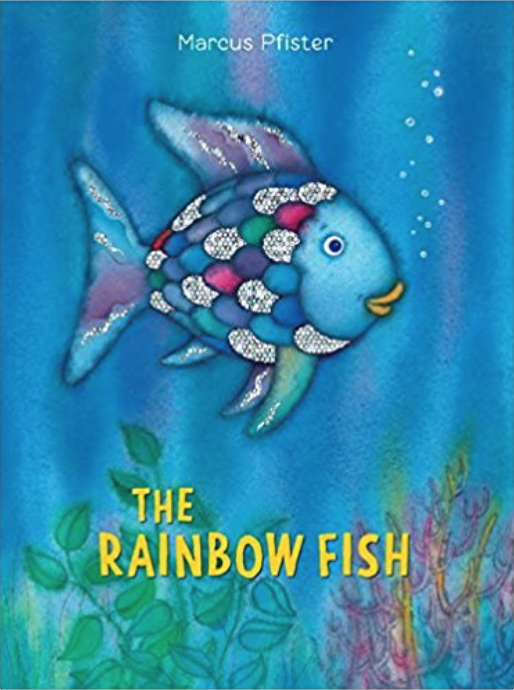
Picture book The Rainbow Fish, written and illustrated by Marcus Pfister, is the story of a rainbow fish who learns about beauty and friendship as he discovers the joy of sharing with others.  Translated by J. Alison James, this book was originally published in 1992 in Switzerland under the title Der Regenbogenfisch, and was published by North-South Books in the U.S. in the same year.  The blues and purples of Pfister’s watercolors are beautiful, but the underwater world they create is sometimes interrupted by all-white, text-only pages.  The namesake fish glimmers across the pages, his holographic scales all over his body on the book’s beginning endpapers in contrast with the single holographic scale left on the final endpapers.  Therein lies the message of the book: the rainbow fish’s vanity keeps him from having any friends until he learns to share his beautiful scales with the other fish who admire his beauty so much. On the one hand, this is a wonderful lesson for children to learn about not being prideful about one’s appearance and learning to give sacrificially, the latter part of this theme reminiscent of Silverstein’s The Giving Tree.  On the other hand, it can leave the reader wondering: should I have to give away my beauty, or any part of myself, to make others happy?  Despite the controversy that sometimes surrounds the message of this book, as with The Giving Tree, its heart seems to be in the right place as Pfister closes the text: “The Rainbow Fish shared his scales left and right.  And the more he gave away, the more delighted he became. When the water around him filled with glimmering scales, he at last felt at home among the other fish…Finally the Rainbow Fish had only one shining scale left.  His most prized possessions had been given away, yet he was very happy.” The beautiful colors and glimmering scales will enchant readers at storytime, and the lesson of generosity, humility, and selflessness is worth sharing and discussing.  

Posted in Book Reviews

An Aussie Adventure

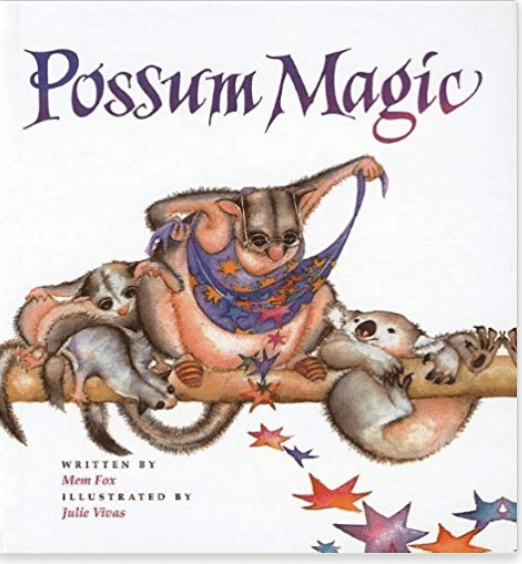
Picture book Possum Magic, written by Mem Fox and illustrated by Julie Vivas, is the charming tale of an invisible possum and her magical grandmother.  Originally published in 1983 by Omnibus Books of Australia, it was published by Voyager Books in 1991 in the U.S. and has come to beloved by readers of many cultures.  Children ages 4-7 and their caregivers will enjoy reading of the adventures of Hush and Grandma Poss as they travel all over Australia eating all kinds of traditional Australian foods (Fox’s map and glossary at the end of the book help with discovering more about these things) in order to make invisible Hush visible again.  Vivas’ illustrations are clever, depicting Hush initially as only an outline but gradually as a full-color possum as her culinary adventure with her grandmother breaks grandma’s spell and makes Hush visible again. This story would make a delightful storytime read as children as introduced to new animals, places, and foods.

Posted in Book Reviews

Adventure Awaits

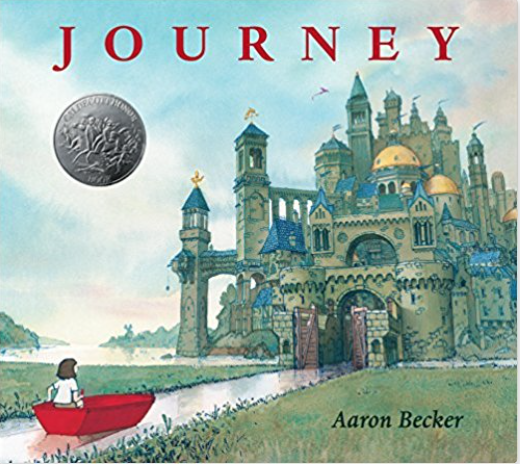
Wordless picture book Journey by Aaron Becker is an exciting tale of adventure for children ages 4-8, but anyone will be entranced by this book’s artwork, pictures which tell the story so well that no words are necessary.  Published in 2013 by Candlewick Press, this 2014 Caldecott Honor Book is reminiscent of Harold and the Purple Crayon but with a story all its own to tell.  The muted pen and ink illustrations at the beginning of the book, brightened only by the color red, depict a lonely girl for whom everyone is too busy.  Picking up a red crayon, she draws a door on her bedroom wall and enters a world of her imagination filled with beautiful watercolors. For each step of her journey, she draws her modes of transportation–a boat, a hot air balloon, a magic flying carpet–but must be set free by a friend that she had freed earlier in the tale: a purple bird.  In an homage to Harold, Becker has subtly placed the color purple throughout the book, even from the first pen and ink spread with a boy on the edge of the page holding a purple crayon.  This story of friendship and adventure will delight readers of all ages.

Posted in Book Reviews

When You Leave a Sandcastle…

Wordless picture book Sea of Dreams by Dennis Nolan is a beautiful work of art that draws you in from its cover with a boat on the crest of a wave and doesn’t let you go until the last page’s sandcastle.  Published in 2011 by Roaring Brook Press, this book is aimed at children ages 4-7, but anyone interested in art and its capacity to tell stories will delight in its pages.  The pictures tell the story of a young girl who builds a sandcastle on the beach and the tiny family who must vacate that sandcastle at night when the tide comes in. The seagull present throughout the story, the return of the little girl to build a taller sandcastle, the light on again at the end of the story…all of these elements leave the reader wondering what happens to the little family, and the lack of text enables the reader to come up with her own interpretation.  Both the story’s realistic and imaginative elements, such as mermaids riding seahorses, are rendered in vibrant, richly saturated hues capable of drawing a reader of any age into this imaginative look at what happens after you head home from a day at the beach, the sandcastle that you built still standing.

Posted in Book Reviews

American Women from A to Z

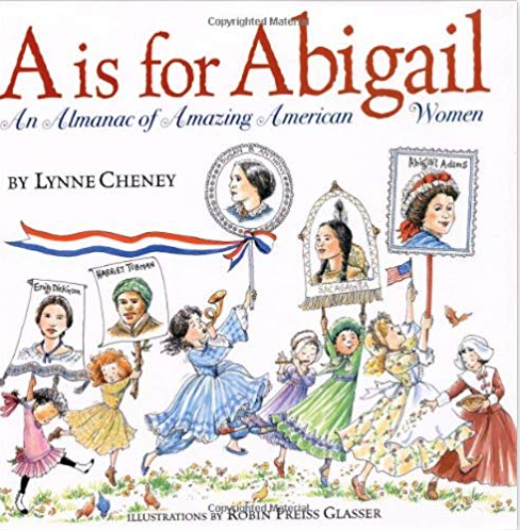
Picture book A is for Abigail: An Almanac of Amazing American Women, written by Lynne Cheney and illustrated by Robin Preiss Glasser, is an alphabet book presenting noteworthy American women to readers ages 6-12.  Published in 2003 by Simon & Schuster Books for Young Readers, the book’s rich details will draw readers in, as there is so much in both the text and illustrations to explore.  The colors and beautiful designs of the pages are enticing, especially the gatefold for the letter P: a curtain stage that reveals a bevy of American female performers. There is so much information packed onto each page that it is a bit visually overwhelming at times, particularly the B page for “Elizabeth Blackwell and others who wanted to heal” as you have to read around triangular pictures to learn about each woman featured.  That fact aside, this text contains a wealth of knowledge that would make a wonderful support for an elementary or middle school history class. Through this text, children will be introduced in an exciting way to many American women whose lives ought to be remembered and modeled.

Posted in Book Reviews

Z Is for Moose?

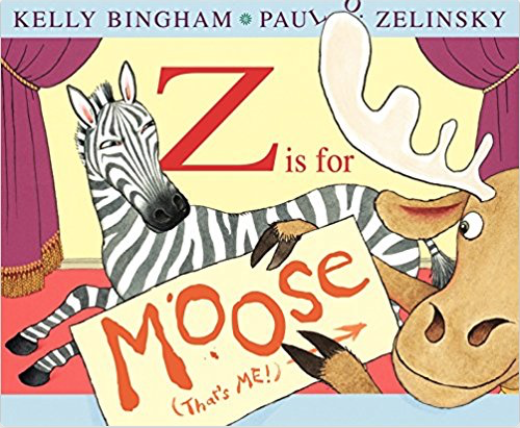
Picture book Z is for Moose, written by Kelly Bingham and illustrated by Paul O. Zelinsky, is a zany story of an impatient moose and his friend zebra, who is organizing an ABC presentation.  Published by Greenwillow Books in 2012, this book is one that is aimed at children ages 4-6, but children of all ages (including those just young at heart) will delight in this silly story, maybe even learning some letters of the alphabet along the way.  The book’s delightfully funny illustrations begin on the endpapers, where we see a moose holding up a curtain, standing in a line of animals before a zebra with a clipboard saying, “Okay, everyone. Let’s get ready.” We continue to be ushered into this world through the acknowledgement and title pages until we see an apple climbing a set of stairs to be the first feature in zebra’s alphabet show.  A, B, C…the book is moving along as expected until “D is for Moose,” a page on which a duck is falling off the back of the stage and zebra is scolding moose for being on the wrong page. The hijinks continue from there until zebra finds a way to work his friend into an unexpected place. While this is not necessarily an alphabet book for caretakers hoping for a clear illustration of each letter and a corresponding word with which to teach their children (the spread for O, P, and Q is trampled upon by a frustrated moose), the humor and unexpected nature of the story make it a fun read for storytime as children squeal with delight, “D is not for Moose!!”

Posted in Book Reviews

Needing Some Alone Time?

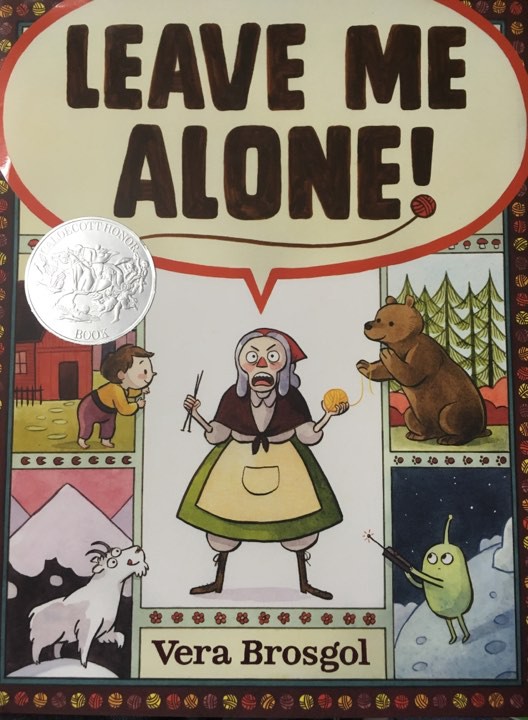
Print picture book Leave Me Alone!, written and illustrated by Vera Brosgol, is a humorous look at balancing one’s love for family with a need for peace and quiet.  Told over 18 spreads and 48 pages, this 2017 Caldecott Honor book is written for preschool-2nd graders, but I’m certain that adults will get as much, if not more, enjoyment out of the text as the children to whom they are reading.

At the beginning of this story, we’re introduced to an old woman who lives in a little house with a big family.  Winter is coming, so she’s trying to get her knitting done, but she can’t find the time or space to do it.  So, she leaves her house to find some peace and quiet.  Her epic journey to be left alone to finish her knitting ensues, ultimately leading her into a wormhole in space.  At the end of the story, she returns home to her family with her 30 knitted sweaters.

I appreciate this book’s use of negative space and the placement of text in relation to the pictures.  I love the spread with the grandchildren curious about her knitting.  The illustrations of the children unraveling balls of yarn are wrapped around the text of the children’s questions about the yarn.  The next spread has a single sentence, “The old woman was at the end of her rope.” with a picture of the old woman staring a single red line on the ground.

Brosgol uses patterned language, repetition, and predictability to tell her story.  For instance, the old woman’s actions to get ready to go on her journey to be alone are the same actions she takes as she prepares to leave the wormhole and head back to her family.  Also, each time the old woman finds a new place to knit, the text tells us where she walked to, what she did before sitting down to knit, what interrupts her, and her response of “Leave me alone!”  This increases the humor of the text, as her many attempts to find solitude are foiled and she must go to ridiculous lengths to find it.

This book would make a fun storytime read, but I wonder if it appeals more to adults reading this text to children than to the children themselves. Kids may find it humorous seeing how far the grandmother goes to be alone, but they may also identify with the children who have been left alone and be concerned. Adults, however, will find this story all too relatable. What caretaker hasn’t needed a moment of peace and quiet?