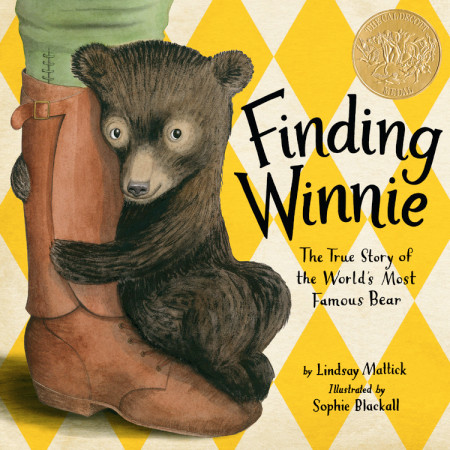
Print picture book Finding Winnie: The True Story of the World’s Most Famous Bear, written by Lindsay Mattick and illustrated by Sophie Blackall, is the true story of the bear behind A. A. Milne’s beloved Winnie the Pooh series. Over 26 spreads and 56 pages, a story unfolds about family, friendship, and the indelible effect of kindness. This 2016 Caldecott Medal book is aimed at children in kindergarten-3rd grade, but it is certainly a story that will enchant their nostalgic parents as well.
The story is bookended by a first-person narrator, the author, telling her son a bedtime story about a bear. She shares the tale of Captain Harry Colebourn, a Canadian veterinarian who buys a bear cub from a trapper at a train stop on his way to his new post at a hospital for horses during WWI. He names her Winnipeg, or Winnie, for short. Then comes Winnie’s journey with Harry and his unit across the Atlantic Ocean to England, where she becomes the mascot of the Second Canadian Infantry Brigade. When the order comes to go to battle, however, at the climax of the book, Harry makes the decision to take Winnie to the London Zoo, her new home. The end of the book picks up a different story: the story of a boy and his father who go to see Winnie at the London Zoo. The boy is Christopher Robin Milne and his father is Alan Alexander Milne, the author who wrote stories all about his son’s friendship with this beloved bear. The end of the book also tells us what happened to Harry and reveals that the narrator telling this story to her son Cole at night is the great-great granddaughter of Captain Harry Colebourn. The last several pages of the book and its endpapers are a family album of pictures, diary entries, and Winnie’s Animal Record Card for the London Zoo.
What really catches the eye about the artwork in this text is the decision to include a family album so that the reader can see the photos and journals that the mother is showing to her son at the end of the story. I love getting to see the real people behind the story. Other than this instance, though, as charming as I find the artwork in this book to be, I don’t find that it adds anything to the text; it merely illustrates it. It does so beautifully, but I wish the illustrations gave you even more details about the story than the text does.
The dominant storytelling technique is that of varying the perspective, alternating between a conversation between the narrator, a mother telling a bedtime story, and her son and the third-person narration of the story of Harry and his bear. I find this to be engaging, as it allows you to discover over the course of the story that the mother telling the story is related to Harry Colebourn, and that the mother is the author of the book. It allows you to hear what the child thinks about the tale, echoing what a child reading the book may be thinking. The illustrations are lovely, and the story is an enchanting one. The thing that really strikes me as brilliant about this text, though, is the author’s use of narrative perspective, how she weaves first-person interjections of the narrator and her son’s exchange over the story at bedtime with the story of Harry and his bear.
This book would make a wonderful storytime read as well as a useful classroom tool for teaching point of view, history, and nonfiction elements. I think this book appeals to children and adults alike. The story’s illustrations and endearing tale of a bear whose name so many recognize makes the text reminiscent of a childhood favorite for some and an introduction to a new friend for others.


 The Mermaid's Tale