
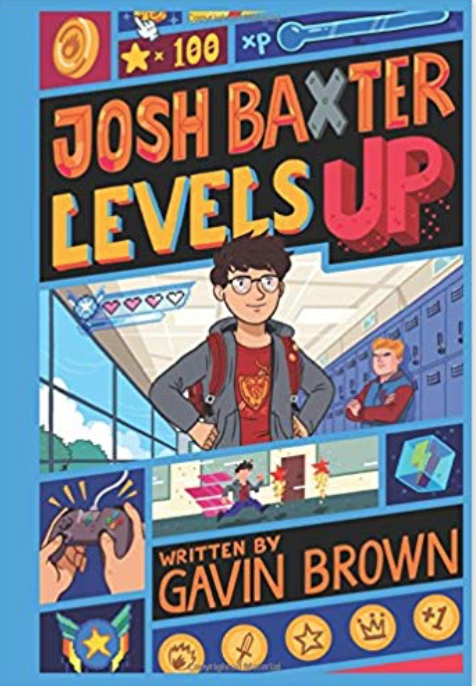
My plan is designed for a school library, but some of the activities, like the coding lessons and reading of the book, could work well in a public library setting as well. My idea is for an eight-week interdisciplinary unit plan centered around Josh Baxter Levels Up for fifth graders involving the school library media specialist and the English language arts, physical education, art, and computer science teachers. There are also opportunities for math and science teachers to get involved as well depending on the school’s curriculum.
Weeks 1-4: In September, the English language arts teachers will teach a unit using Josh Baxter Levels Up, providing opportunities for the students to learn new vocabulary as well as lessons about plot, characterization, conflict, and theme. In addition, any new students will be paired with a buddy to help them navigate their new school environment. All other students will also be paired up; each pair of students will write a first-person narrative featuring a protagonist who must overcome something difficult or adjust to a new environment.
Weeks 1-5: During that month, the media specialist will organize an Hour of Code event through code.org, giving students the basics in coding. Josh thinks of his world in terms of the video games he plays, so students will get an opportunity as a part of this unit to learn about coding and to bring the stories they wrote to life. During the fifth week of this unit, the computer teachers will work with the library media specialist to organize class periods during which students will use Scratch, an MIT project available for free use, to create their stories digitally. I like this format because, much like Google Classroom, educators can create free accounts from which they can create student accounts and manage class projects. ScratchEd is developed and supported by the Harvard Graduate School of Education, providing educators with an online community of teachers sharing ideas and resources, as well as in-person meeting opportunities. Additionally, there are tutorials, educator guides, and a Creative Computing Guide available as resources. I also like Hopscotch as a story animation resource, if for nothing else than for teachers to view the one-hour lesson plan complete with Common Core ELA Standards that is provided.
Weeks 6-7: After learning to animate their stories, students will continue to work on this project during a two-week period by creating story-based games in computer class with help from the school library media specialist. They will use Stencyl to do this, an online resource whose “drag-and-drop gameplay designer pays homage to the successful MIT Scratch project. We extend Scratch’s simple block-snapping interface with new functionality and hundreds of ready-to-use blocks.” Educators can use the free Educator’s Kit to teach this unit, a resource which provides two weeks of lesson plans and activities to support students’ creation of games based on their stories.
Week 8: Finally, after students have created their stories and games, the media specialist will curate the games on the library’s website so that fifth grade students can play them during the eighth week of the unit. Kids will vote for their favorite, and the winner will be turned into a real-life game that students will create in the gym with the help of physical education and art teachers.
Weeks 9-10: During the ninth and tenth weeks of the unit, in English class for three class periods, students will work on turning the computer game into a real-life playable experience. Because there will be multiple classes working on this, each class will post their planning progress on a large sheet of paper at the front of the classroom, so that the next class can continue adding to the plan. Phys. ed teachers will give students a list of physical movements to incorporate into the real-life gameplay, such as sit-ups, pull-ups, jumping jacks. During three class periods, art teachers will help kids design and create posters, cutouts, or other artwork to hang around the gym to create the world of the game that kids will play in gym class. The following week, phys. ed teachers will give students one period to set up their game in the gym so that classes can play it during gym class that week, with a trophy awarded to the team with the highest score.
By the end of this unit, students will not only have strengthened their language arts skills, but will have learned the basics of coding, used artistic skills, gotten some exercise, and built relationships with each other that encourage collaboration and teamwork.
 The Mermaid's Tale